Built to the Standards Nursing Education Actually Requires
Every quiz question NursingEdAI generates passes six automated quality stages before it reaches you. Here is what those stages are and why each one matters.
Last updated: June 2026
The Six-Stage Content Pipeline
Most AI tools generate and stop. NursingEdAI runs every output through a structured review sequence before delivery. No question reaches faculty without passing all six stages.
Generate
RICCE (Role, Instructions, Context, Constraints, Examples) framework prompt specifies the clinical domain, practice track, and Bloom's taxonomy level — establishing exactly what the content needs to reflect.
Evidence Load
Current clinical practice guidelines and nursing certification standards for the specified domain and track are loaded as active reference context. Content is grounded in this evidence base — not in general AI training data.
Self-Critique
The model reviews its own draft for ambiguity, cueing, distractor logic, clinical accuracy, and drug naming before producing a revised version.
Symmetry Check
A quantitative word-count audit enforces the 20% length threshold across all four answer options. Violations trigger revision — not a flag to the user.
Distribution Audit
Correct answer positions are counted across the full quiz. The audit gate halts delivery if any letter falls outside the 20–30% target range and redistributes automatically.
Deliver
Content that has passed all five prior stages is delivered in faculty's chosen format: Word Document (.docx), PDF, ExamSoft, HTML, or PowerPoint (.pptx).
Faculty see only the final output. All pipeline stages run automatically in the background.
Exams That Test Reasoning — Not Pattern Recognition
AI-generated quizzes have a well-documented construction flaw: the correct answer is almost always the longest, most detailed option. Students learn to scan for length instead of reasoning through the clinical scenario. They pass exams while practicing the wrong clinical reflex.
NursingEdAI enforces a quantitative word-count rule at Stage 3 of every generation: all four answer options must fall within 20% of each other in length. This is not a prompt suggestion — the system audits the output and revises before delivery if any option violates the threshold.
The result: questions that cannot be answered correctly by pattern-matching on length. Every question requires clinical reasoning.
Answer Distribution — 20-Question Quiz
Balanced Answer Keys — No Positional Bias
If correct answers cluster in position A or concentrate in position D, experienced students exploit the pattern without reasoning through clinical scenarios. This is a test construction flaw that degrades exam validity.
NursingEdAI enforces a 20–30% correct-answer target for each position across a quiz set. No single letter exceeds 30% of total questions. No five consecutive questions share the same correct answer position.
An audit gate runs automatically after every generation. If any position falls outside the target range, the system redistributes and re-audits before delivery. Faculty receive a quiz with a key built entirely on clinical merit, not positional patterns.
Clinical Content That Reflects Current Practice
NursingEdAI content is structured against current clinical practice guidelines — ACC/AHA, ANCC, AANPCB, and NCLEX-RN Next Generation standards — as appropriate for the clinical domain and practice track. Every generated scenario includes realistic vital signs, evidence-based interventions, and rationales that cite the current guideline basis.
Board examinations reflect current practice. A question written against 2019 guidelines does not just lower a student's score — it actively trains the wrong clinical reflex for the patients they will treat.
The right guideline, in under a second.
It reads your prompt and matches it to the appropriate clinical practice guideline in under a second, then grounds the content in that guideline before it writes. This runs for graduate NP tracks: acute care, family, psychiatric mental health, and pediatric NP. For prelicensure programs, prompts are loaded with national standards for nursing practice.
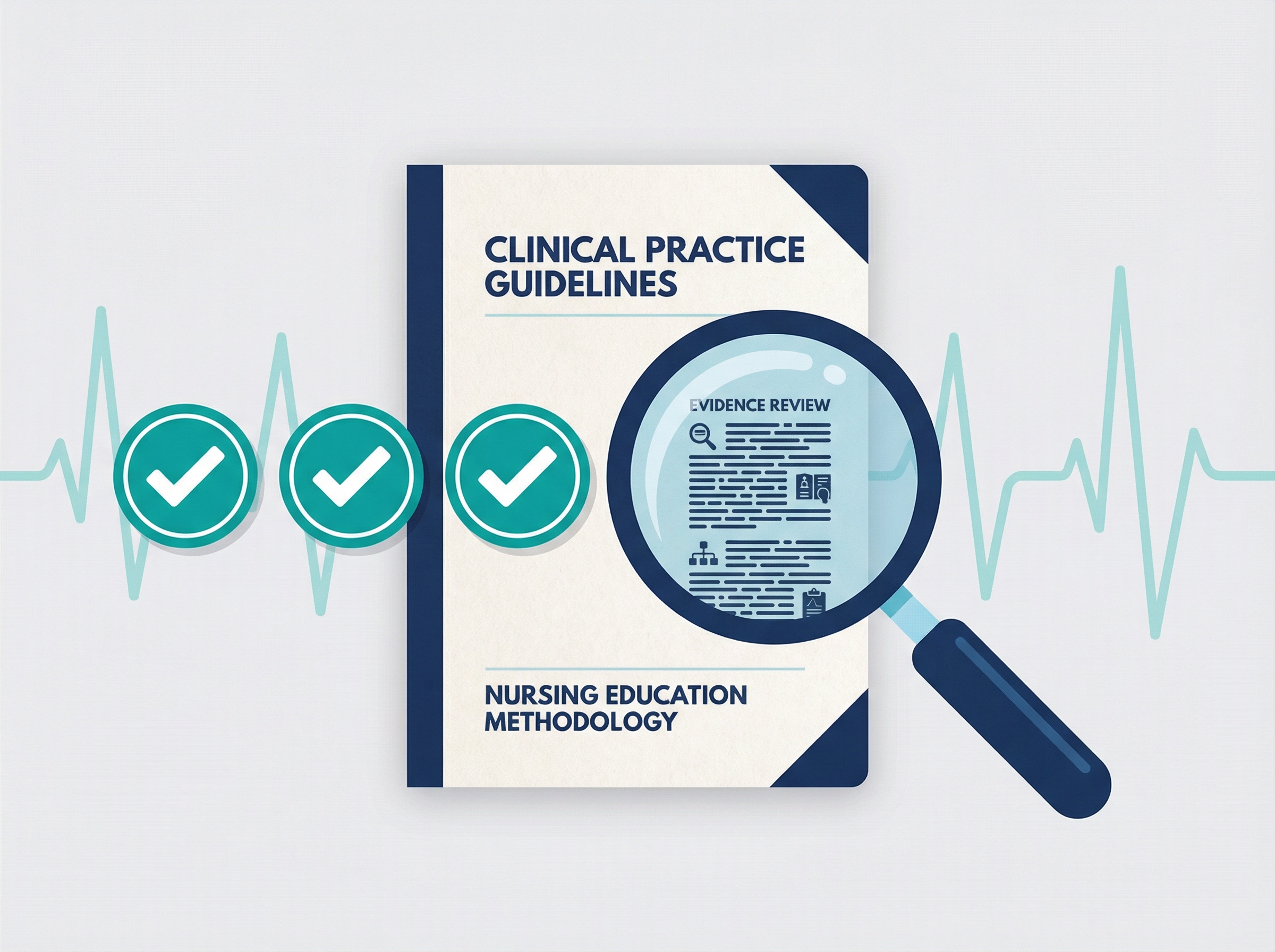
Guideline-Anchored Rationales
Every rationale is written to current clinical practice standards. The guideline basis is explicit in the explanation — not implied or assumed.
AI-Assisted Drift Detection
An AI-assisted audit system reviews rationale content for guideline drift. When the evidence base for a clinical recommendation shifts, affected questions are flagged for revision before distribution.
Validation Timestamps
Clinical validation dates are tracked for questions in NursingEdAI's content pipeline. Faculty generating new content receive material built against the current guideline state at time of generation.
Scope-of-Practice Enforcement — Every Generation
Generic AI tools generate nursing content without tracking the distinction between registered nurse practice and advanced practice authority. A prelicensure case study that asks an RN to select a medication dose is not a clinical scenario — it is a clinical error embedded in course material.
NursingEdAI enforces scope-of-practice guardrails at the system level for each track. These are embedded in the generation prompt — not post-hoc filters. The model cannot produce a prelicensure question that asks a student to prescribe or adjust medications.
Pre-Licensure — ADN, BSN, ABSN, DEMSN
Students are never asked to prescribe, select, or adjust medications. Pharmacology questions address mechanism, expected effect, adverse effects to monitor, and patient teaching — all within RN practice authority. The Activity Engine now supports all four pre-licensure tracks and calibrates complexity to each level.
ACNP Track — Acute Care NP
Scenarios reflect acute care presentations: inpatient, ICU, step-down, emergency, and procedural settings. Outpatient chronic disease management does not appear in ACNP-track content.
FNP Track — Family NP
Scenarios reflect outpatient and primary care settings. Acute inpatient clinical management is outside scope and does not appear in FNP-track content.
PMHNP, PNP-AC, PNP-PC Tracks
Each track receives scope-specific guardrails. Psychiatric-mental health scenarios stay within behavioral and pharmacologic scope. Pediatric tracks reflect age-appropriate presentations and weight-based dosing norms for acute (PNP-AC) or primary care (PNP-PC) settings.
Content Every Student in Your Program Can Use
NursingEdAI interactive case studies and practice quizzes meet Section 508 and WCAG 2.1 AA accessibility standards. This is a requirement for any content distributed to students at programs that receive federal funding — not a differentiating feature, but a baseline that most AI-generated content does not meet.
When a student selects an answer, the screen reader announces whether the response was correct or incorrect — not just a color change, but explicit text feedback. aria-live regions are initialized at render time, not on click, which is the correct implementation for VoiceOver, JAWS, and NVDA compatibility.
Faculty at programs with students who require assistive technology can use NursingEdAI content without accommodation workarounds.
Accessibility Standards Met
Section 508 Compliant
Required for federal funding recipients.
WCAG 2.1 AA
International web accessibility standard.
Screen Reader Announcements
VoiceOver, JAWS, and NVDA. Feedback announced on selection.
Color + Text Feedback
Never color alone. Explicit "Correct" / "Incorrect" text on every response.
ES5 JavaScript
Compatible with older institutional browsers and screen reader browser pairings.
Every Standard Here Was Built in a Classroom
NursingEdAI was designed by Paul Logan, PhD, CRNP — AG-ACNP Program Director at Saint Joseph's University and clinician at WellSpan Cardiology. The standards enforced by the platform are the standards he applies to his own course materials each semester.
The scope-of-practice rules come from what he teaches in the AG-ACNP program. The clinical standards come from the guidelines he uses in his own practice. The distractor symmetry rule exists because he spotted the flaw in early AI output before distributing anything to students. The accessibility requirements came when a student needed them.
This is not a generic AI product adapted for nursing education after the fact. It was built from the inside of a graduate nursing program, by someone who uses it there.
Paul Logan, PhD, CRNP • AG-ACNP Program Director, Saint Joseph's University • WellSpan Cardiology • University of Pennsylvania, 1994
About the creator ›Questions About the Methodology
Specific answers for faculty evaluating NursingEdAI for their programs.
How does NursingEdAI prevent the "longest answer is correct" problem?
This is a recognized test-construction flaw. NursingEdAI enforces a quantitative word-count rule: all four answer options must fall within 20% of each other in length. The platform self-audits every question before delivery. If any option violates the threshold, the generation step revises before the question reaches faculty. This is enforcement — not a prompt suggestion to the model.
How do I know the clinical content is up to date?
NursingEdAI content is generated against current clinical practice guidelines — ACC/AHA, ANCC, AANPCB, and NCLEX-RN Next Generation standards as appropriate for the clinical domain. An AI-assisted audit system reviews rationale content for guideline drift; content that fails the audit is flagged for revision before distribution. Faculty should always review generated content for accuracy before using it in assessments.
How does NursingEdAI enforce scope of practice?
Scope-of-practice guardrails are embedded in the system prompt for each track, not added as best-effort guidance. Pre-licensure content (ADN, BSN, ABSN, DEMSN) never asks students to prescribe, select, or adjust medications. ACNP-track scenarios reflect acute care presentations only. FNP-track scenarios reflect outpatient and primary care. PMHNP, PNP-AC, and PNP-PC tracks each carry their own scope constraints. These guardrails are structural; the model cannot override them.
Can students using screen readers access NursingEdAI case studies?
Yes. NursingEdAI interactive case studies and practice quizzes meet Section 508 and WCAG 2.1 AA standards. Feedback panels are announced by VoiceOver, JAWS, and NVDA when a student selects an answer — as explicit text, not color alone. aria-live regions are initialized at render time, which is the correct implementation for screen reader compatibility.
Who reviews AI-generated content for clinical accuracy?
NursingEdAI was designed by Paul Logan, PhD, CRNP — AG-ACNP Program Director at Saint Joseph's University and clinician at WellSpan Cardiology. The clinical accuracy standards, scope-of-practice guardrails, and exam construction rules are the standards he applies to his own course materials. Faculty remain responsible for reviewing content before distributing to students — the same standard that applies to any purchased question bank.
Is AI-generated nursing content appropriate for an accredited program?
AI-generated content is appropriate when it meets the same construction standards as faculty-authored or commercially purchased content — balanced answer distribution, clinically accurate rationales, scope-appropriate scenarios, and exam construction principles that test reasoning rather than pattern recognition. NursingEdAI enforces these standards automatically. Faculty review generated content before use, consistent with standard practice for any externally sourced assessment material.
See the methodology in action
Generate your first quiz — free, no credit card required.